画蛇添足
Huà shé tiān zú
"To draw a snake and add feet to it"
Quick Answer
画蛇添足 (Huà shé tiān zú) — "To draw a snake and add feet to it." Literal translation: Drawing a snake and then adding feet, as if the snake needed them. Ruining something by overdoing it. Adding unnecessary elements that make the result worse, not better.
Character Analysis
Drawing a snake and then adding feet, as if the snake needed them
Meaning & Significance
Ruining something by overdoing it. Adding unnecessary elements that make the result worse, not better.
Historical Origin
About This Entry
You finished the project. It was good. Clean, clear, effective. Then you decided to add “just one more thing.” And suddenly it’s a mess.
画蛇添足. You drew a snake and added feet.
The Characters
- 画 (huà): To draw, to paint
- 蛇 (shé): Snake
- 添 (tiān): To add, to append
- 足 (zú): Foot, feet
This is a four-character chengyu (成语) — a classical Chinese idiom.
Where It Comes From
This proverb comes from a famous story in Zhan Guo Ce (《战国策》, “Strategies of the Warring States”), a collection of political and military anecdotes from the 4th–3rd centuries BCE.
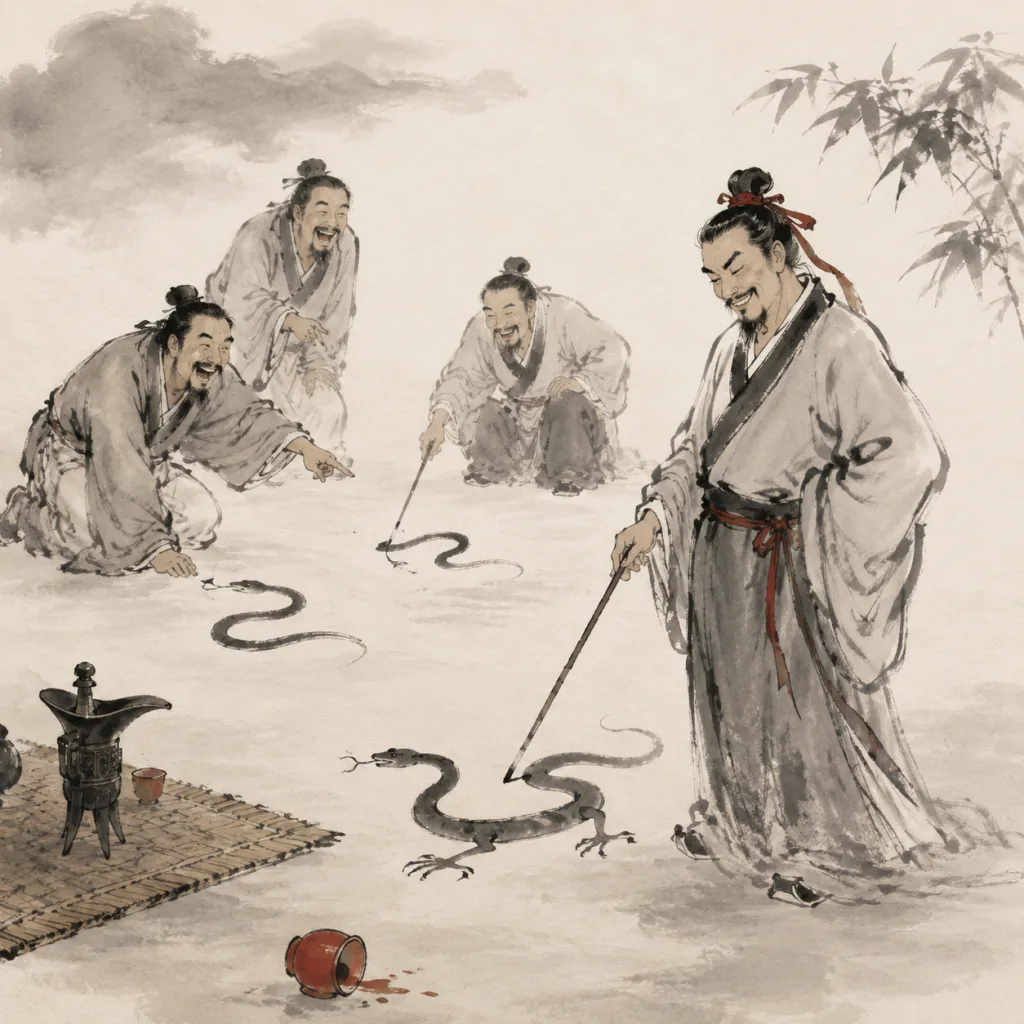
A group of officials in the State of Chu were given a pot of wine as a reward. There wasn’t enough for everyone, so they agreed on a competition: whoever could draw a snake on the ground the fastest would win the wine.
One man finished his snake quickly. He looked around and saw that no one else was close to finishing. Feeling smug, he decided to show off. He picked up his stick and began adding feet to his already-complete snake.
While he was adding feet, another man finished his snake, grabbed the pot, and drank the wine.
“Snakes don’t have feet,” the second man said. “What you drew is not a snake.”
The first man lost the wine he had already won, all because he couldn’t leave well enough alone.
The Philosophy
The Art of Stopping
This proverb is about a specific kind of mistake: not doing too little, but doing too much. The person who added feet wasn’t lazy or incompetent. He was too skilled for his own good. He had time to spare and used it to destroy his own work.
There’s a deep lesson here about knowing when to stop. In art, in writing, in design, in business — the last 10% of effort often produces negative returns. The extra feature that complicates the product. The extra paragraph that weakens the argument. The extra note that ruins the song.
Perfectionism as Self-Sabotage
The man who added feet was a perfectionist. He looked at his snake and thought, “It could be better.” But “better” is subjective, and in this case, his addition made the result categorically wrong. A snake with feet is not a snake.
This is the perfectionist’s trap: the inability to recognize when something is already good enough. The pursuit of “more” can destroy what “enough” already achieved.
Over-Engineering
In modern terms, this proverb perfectly describes over-engineering. The simple solution works. The complex solution introduces bugs, maintenance costs, and confusion. The best code is the code you don’t write. The best feature is the one you don’t add.
When Chinese Speakers Use It
Scenario 1: Criticizing someone’s unnecessary addition
“The report was perfect at ten pages. Why did you add twenty more?”
“Huà shé tiān zú. Now it’s bloated and nobody will read it.”
Scenario 2: In design or creative work
“The logo was clean and elegant. Then the client asked to add a gradient, a shadow, and a tagline.”
“Classic huà shé tiān zú. It went from professional to amateur in one revision.”
Scenario 3: In software development
“The feature was working fine. Then the lead developer decided to refactor the entire architecture.”
“Huà shé tiān zú. Three weeks of work, and now nothing works.”
In Western Culture
This chengyu is well-known among Chinese culture enthusiasts and is frequently cited in English-language articles about Chinese idioms. The closest English equivalent is “gilding the lily” — decorating something that’s already beautiful, thereby ruining its natural perfection.
Tattoo Advice
Good choice for a minimalist.
Four characters, clean visual balance, and a meaningful message about restraint. This tattoo says: “I know when to stop.” That’s an attractive quality.
The imagery of a snake is also visually compelling for tattoo art. Combined with the calligraphy, it makes a strong design.
One consideration: make sure people understand it’s about not overdoing things, not about snakes. The meaning is positive — it celebrates knowing when enough is enough.
See Also
Frequently Asked Questions
What does "画蛇添足" mean in English?
To draw a snake and add feet to it
How do you pronounce "画蛇添足"?
The pinyin pronunciation is: Huà shé tiān zú
What is the deeper meaning of "画蛇添足"?
Ruining something by overdoing it. Adding unnecessary elements that make the result worse, not better.
What is the literal translation of "画蛇添足"?
Drawing a snake and then adding feet, as if the snake needed them
Where does "画蛇添足" come from?
This proverb originates from 战国策 (Zhan Guo Ce) (Warring States period content, Han dynasty compilation), attributed to Compiled by Liu Xiang (刘向).
Related Proverbs
少说为妙
Shǎo shuō wéi miào
"Less said, better — silence is often the wisest choice"
三十而立
Sān shí ér lì
"At thirty, I stood firm"
满瓶不动半瓶摇
Mǎn píng bù dòng bàn píng yáo
"A full bottle stays still; a half-full bottle shakes"
失败是成功之母
Shībài shì chénggōng zhī mǔ
"Failure is success's mother"
授人以鱼不如授人以渔
Shòu rén yǐ yú bùrú shòu rén yǐ yú
"Giving someone a fish is not as good as teaching them to fish"
留得青山在,不愁没柴烧
Liú dé qīngshān zài, bù chóu méi chái shāo
"As long as the green mountain remains, there's no need to worry about firewood"