Funny Chinese Proverbs & Humorous Sayings
Chinese humor has its own distinct flavor: dry, observational, and often brutally direct. It shows up in unexpected comparisons and in the gap between how things are supposed to work and how they actually turn out.
These proverbs deploy vivid, sometimes absurd imagery to score their points. A lazy person isn’t just lazy — they’re a “salted fish” lying flat. Someone who interferes where they don’t belong is a “dog catching mice.” The comedy lands through the sheer unexpectedness of the metaphor, delivered with a straight face.
This collection gathers the lighter side of Chinese wisdom. These sayings suggest that not taking yourself too seriously might itself be a form of wisdom — and that sometimes the best way to make a point is to make someone laugh first.
Top 5 Funny Chinese Proverbs
New to Chinese humorous sayings? These five are widely quoted and cover the main comedic registers — dumb luck, deception, meddling, mismatched roles, and defiant apathy.
1. 瞎猫碰上死耗子 (Xiā māo pèng shàng sǐ hào zi) — “A blind cat stumbles upon a dead mouse.” Pure dumb luck — success without skill, merit, or intention. Read more →
2. 挂羊头,卖狗肉 (Guà yáng tóu, mài gǒu ròu) — “Hang a sheep’s head, sell dog meat.” The classic image for bait-and-switch deception. Read more →
3. 狗拿耗子多管闲事 (Gǒu ná hào zi duō guǎn xián shì) — “A dog catching mice — meddling in what’s not its business.” A deadpan takedown of busybodies. Read more →
4. 赶鸭子上架 (Gǎn yā zi shàng jià) — “Driving a duck onto a perch.” Forcing someone into a role they’re fundamentally unsuited for. Read more →
5. 死猪不怕开水烫 (Sǐ zhū bù pà kāi shuǐ tàng) — “A dead pig fears no boiling water.” The original “lying flat” — someone past caring. Read more →
Browse Funny Chinese Proverbs by Type
Not all Chinese humor works the same way. Use these shortcuts to find what you’re after:
- Sarcastic & sharp: backhanded compliments and takedowns of pretension.
- Food & eating sayings: Chinese humor loves food metaphors — salted fish, vinegar, tofu.
- Animal jokes: dogs, cats, donkeys, and the unforgettable “riding a donkey looking for a donkey.”
- Self-deprecating: the comedy of failure, laziness, and talking big.
Sarcastic & Sharp Sayings {#sarcastic}
Chinese sarcasm tends to be understated. Instead of calling someone arrogant directly, a speaker might say he doesn’t even know his own weight. The comedy is in the listener doing the math. These sayings puncture pomposity without raising the volume — perfect for the dry retort in a meeting or the withering reply to a self-important relative.
Food & Eating Sayings {#food}
No culture jokes about food more than China. To call someone “salted fish” (xián yú) is to call them ambitionless. “Eating tofu” means casually copping a feel. “Drinking vinegar” means being jealous (the Mandarin word for vinegar, 醋, doubles as “jealousy”). The culinary metaphor lands instantly because everyone shares the reference.
Animal Jokes {#animals}
Animals carry centuries of comedic baggage in Chinese sayings. Dogs are meddlers or strays. Donkeys are stubborn. Foxes are schemers. The “dog catching mice” proverb (a dog has no business catching mice — that’s the cat’s job) mocks busybodies. The donkey-riding proverb mocks anyone searching desperately for the thing they’re already sitting on.
Self-Deprecating Sayings {#self-deprecating}
The funniest Chinese proverbs often come at the speaker’s own expense. Classic examples include calling oneself a salted fish, describing one’s own talk as “three parts hot air,” and the famous anti-proverb about drawing a snake and then adding legs because you can’t stop yourself. Self-deprecation here isn’t low self-esteem — it’s a sign of confidence.
Frequently Asked Questions About Funny Chinese Sayings
Are Chinese proverbs ever actually funny? Yes — though the humor is usually dry, deadpan, or absurd rather than punchline-driven. The comedy comes from unexpected comparisons (“a dog catching mice,” “salted fish”) delivered with a straight face.
What’s the funniest Chinese idiom? A strong candidate is 画蛇添足 (huà shé tiān zú, “drawing a snake and adding feet”). It describes someone who ruins a perfectly good thing by overdoing it — imagining a competitive draughtsman who wins a wine-drinking contest, then can’t resist drawing legs on his finished snake and losing.
Why are there so many Chinese food sayings? Food is central to Chinese social life, so culinary terms are universally understood shorthand. Calling someone salted fish, telling them they “eat tofu,” or describing jealousy as “drinking vinegar” all land instantly without explanation.
Can I use funny Chinese proverbs in conversation? Yes — they’re meant to be quotable. The trick is timing. A well-placed “you’re riding a donkey looking for a donkey” gets a laugh; an ill-placed one sounds like a non-sequitur. Use them sparingly, and pick ones whose imagery is self-explanatory in English.
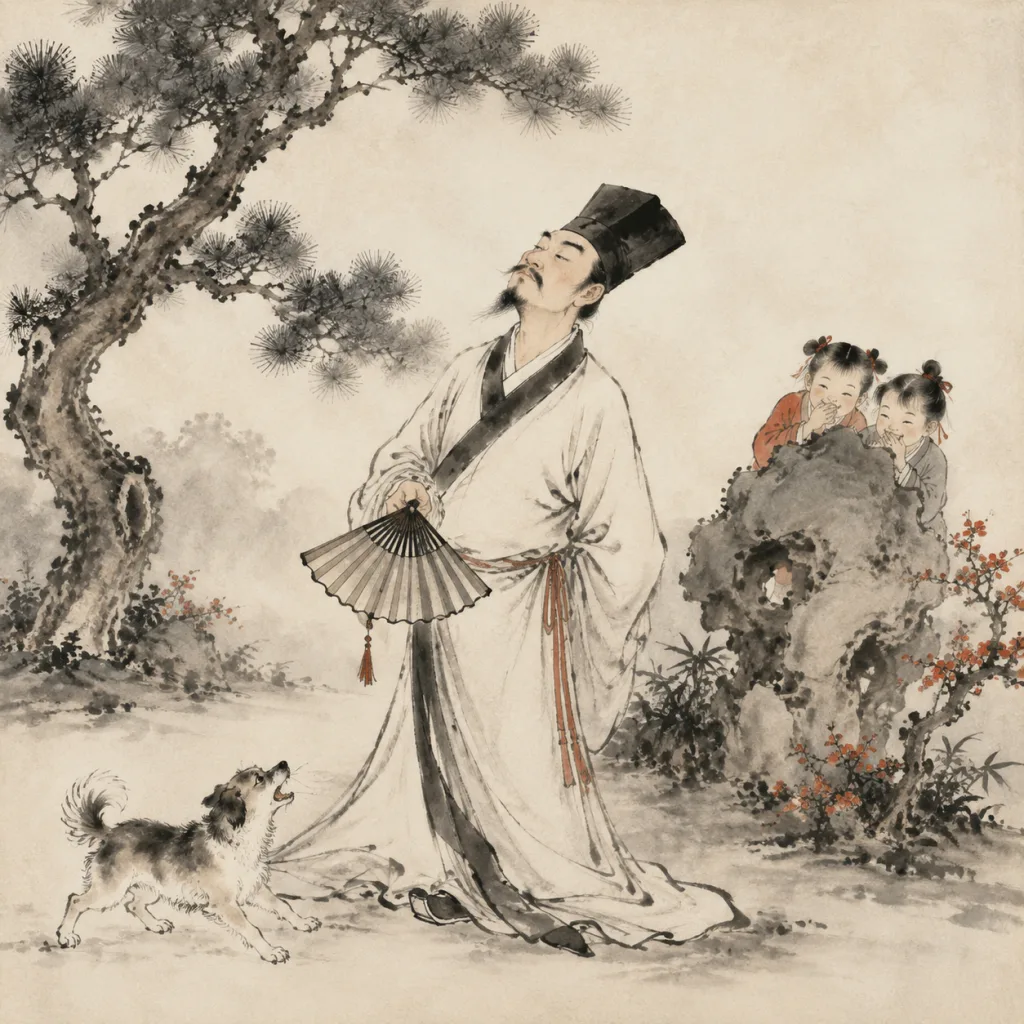
孔夫子搬家——净是书(输)
Kǒng Fūzǐ bān jiā — jìng shì shū (shū)
"Confucius moves house — nothing but books (a pun: 'books' sounds identical to 'losses')"
死猪不怕开水烫
Sǐ zhū bù pà kāi shuǐ tàng
"A dead pig does not fear scalding water"
狗拿耗子多管闲事
Gǒu ná hào zi duō guǎn xián shì
"A dog catching mice — meddling in affairs that aren't its business"
姜太公钓鱼——愿者上钩
Jiāng Tàigōng diào yú — yuàn zhě shàng gōu
"Jiang Taigong fishes — let the willing ones get hooked"
肉包子打狗——有去无回
Ròu bāozi dǎ gǒu — yǒu qù wú huí
"A meat bun thrown at a dog — gone, no return"
外甥打灯笼——照旧(照舅)
Wàisheng dǎ dēnglong — zhào jiù (zhào jiù)
"A nephew holds the lantern — lighting the way for his uncle (a pun: 'lighting the uncle' sounds identical to 'same as before')"
老而不死是为贼
Lǎo ér bù sǐ shì wéi zéi
"Old and not yet dead — this is to be a thief"
猪八戒照镜子——里外不是人
Zhū Bājiè zhào jìng zi — lǐ wài bù shì rén
"Zhu Bajie looking in the mirror — neither inside nor outside is a person"
骑驴看唱本——走着瞧
Qí lǘ kàn chàng běn — zǒu zhe qiáo
"Riding a donkey, reading the opera script — we'll see as we go"
擀面杖吹火——一窍不通
Gǎn miàn zhàng chuī huǒ — yī qiào bù tōng
"Blowing fire through a rolling pin — not a single opening works"
秀才遇到兵——有理说不清
Xiùcai yù dào bīng — yǒu lǐ shuō bù qīng
"A scholar meets a soldier — having reason, cannot make it heard"
说曹操,曹操到
Shuō Cáo Cāo, Cáo Cāo dào
"Speak of Cao Cao, and Cao Cao arrives"
占着茅坑不拉屎
Zhàn zhe máo kēng bù lā shǐ
"Occupying the latrine without taking a shit"
脱裤子放屁
Tuō kù zi fàng pì
"Taking off one's pants to fart"
王小二过年——一年不如一年
Wáng Xiǎoèr guò nián — yī nián bù rú yī nián
"Wang Xiaoer celebrates the new year — each year worse than the last"
既当婊子又立牌坊
Jì dāng biǎo zi yòu lì pái fāng
"Being a whore and erecting a chastity arch"
周瑜打黄盖——一个愿打,一个愿挨
Zhōu Yú dǎ Huáng Gài — yī gè yuàn dǎ, yī gè yuàn āi
"Zhou Yu beats Huang Gai — one is willing to beat, the other is willing to be beaten"
瞎猫碰上死耗子
Xiā māo pèng shàng sǐ hào zi
"Pure dumb luck; a fortunate accident"
半路里杀出个程咬金
Bàn lù lǐ shā chū gè Chéng Yǎojīn
"An unexpected challenger emerges midway"
赶鸭子上架
Gǎn yā zi shàng jià
"Forcing a duck to climb onto a roost"
大水冲了龙王庙
Dà shuǐ chōng le lóng wáng miào
"Great flood washes away the Dragon King's Temple"
风马牛不相及
Fēng mǎ niú bù xiāng jí
"Wind, horses, and cattle do not reach each other"
此地无银三百两
Cǐ dì wú yín sān bǎi liǎng
"No silver here, three hundred taels"
牛头不对马嘴
Niú tóu bù duì mǎ zuǐ
"An ox head does not match a horse's mouth"
偷鸡不成蚀把米
Tōu jī bù chéng shí bǎ mǐ
"Failed to steal the chicken and lost the rice used as bait"
挂羊头,卖狗肉
Guà yáng tóu, mài gǒu ròu
"Hanging up a sheep's head while selling dog meat"
猫哭老鼠假慈悲
Māo kū lǎo shǔ jiǎ cí bēi
"When the cat cries over the mouse, it is fake mercy"