井底之蛙
Jǐng dǐ zhī wā
"The frog at the bottom of the well"
Quick Answer
井底之蛙 (Jǐng dǐ zhī wā) — "The frog at the bottom of the well." Literal translation: A frog living at the bottom of a well, seeing only a small patch of sky above, believing that tiny circle is the entire world. This proverb describes someone with limited experience or narrow perspective who mistakes their small worldview for the whole of reality — unaware of how much they don't know. Used when One of the most widely used Chinese idioms for narrow perspective. Quoted in everyday conversation, education, and critique of parochialism. The original Zhuangzi passage features a sea turtle describing the Eastern Ocean to a frog in a shallow well.
Character Analysis
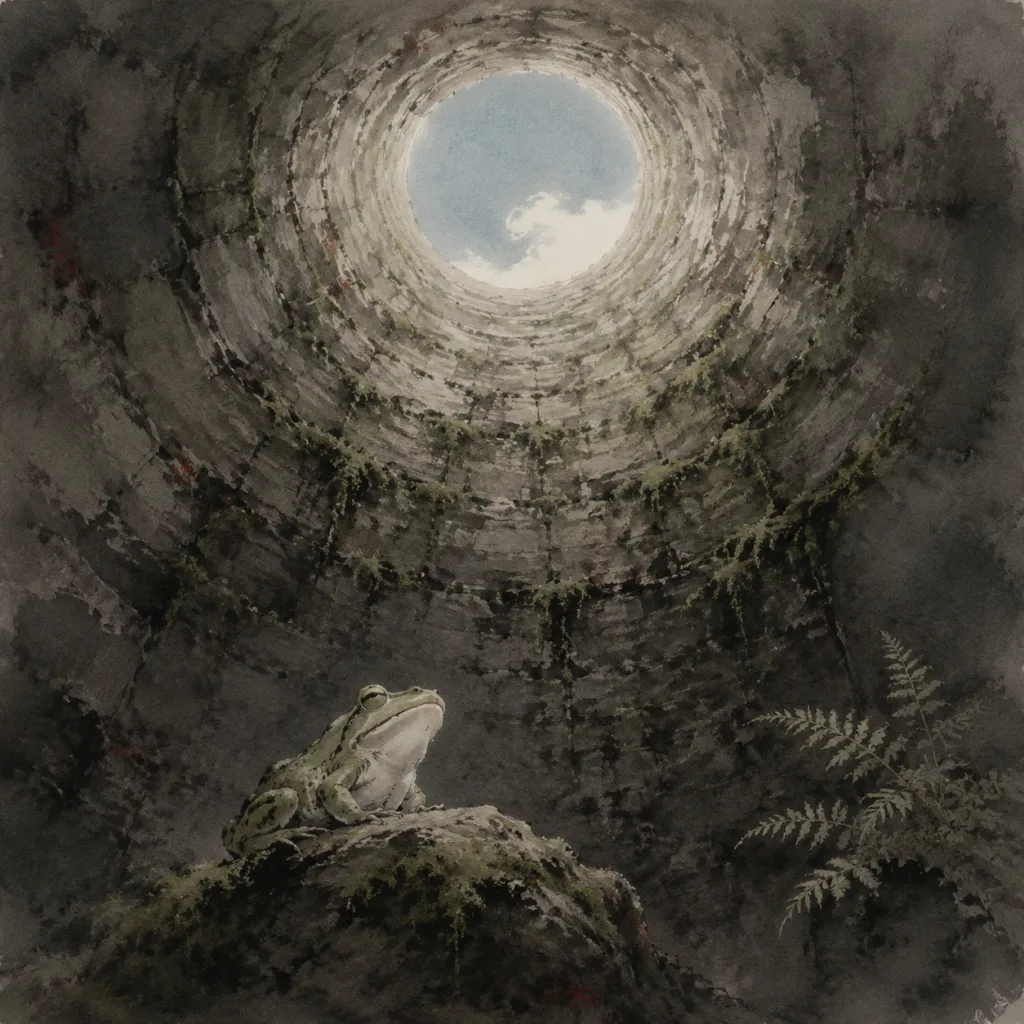
A frog living at the bottom of a well, seeing only a small patch of sky above, believing that tiny circle is the entire world
Meaning & Significance
This proverb describes someone with limited experience or narrow perspective who mistakes their small worldview for the whole of reality — unaware of how much they don't know.
Historical Origin
Modern Usage
One of the most widely used Chinese idioms for narrow perspective. Quoted in everyday conversation, education, and critique of parochialism. The original Zhuangzi passage features a sea turtle describing the Eastern Ocean to a frog in a shallow well.
You’re certain you’re right. The evidence is right there in front of you. Anyone can see it.
Then someone shows you a map. And you realize you’ve been looking at one square meter of an entire continent.
That’s the frog in the well.
The Characters
- 井 (jǐng): Well — a deep hole dug into the ground to access water
- 底 (dǐ): Bottom, base, foundation
- 之 (zhī): Possessive particle — like “of” or ‘s
- 蛙 (wā): Frog
The grammar is simple: “Well’s frog” or “Frog of the well bottom.” The frog belongs to the well. The well is its entire universe.
Where It Comes From
This proverb originates from a story in the Zhuangzi (庄子), one of the foundational texts of Daoist philosophy, written around the 4th century BCE. The full story is worth knowing.
A frog lived in an abandoned well. One day, a sea turtle from the Eastern Ocean arrived. The frog, proud of his home, boasted:
“Look at this! I can hop along the railing when I go out, or rest in a hole in the brick when I come in. I can swim supporting only my armpits, or walk through the mud covering only my feet. Those crabs and tadpoles can’t compare to me. I’m master of this well, free to do as I please. This is the peak of happiness! Why don’t you come down and see?”
The sea turtle tried. But before his left foot could enter, his right knee was already stuck. He backed out and told the frog about the ocean:
“Have you seen the ocean? Its distance is a thousand li, its depth a thousand fathoms. In the time of Yu the Great, there were floods for nine years in ten, but the ocean didn’t rise. In the time of Tang of the Shang, there were droughts for seven years in eight, but the ocean didn’t fall. It doesn’t change whether water flows in or stops. That’s the joy of living in the Eastern Ocean.”
The frog was stunned. He felt small. For the first time, he understood how small.
Zhuang Zhou, the author of the Zhuangzi, used this story to critique limited thinking. He was writing during the Warring States period (475–221 BCE), when rival philosophers constantly claimed exclusive access to truth. Zhuangzi thought they were all frogs — each defending their own well, none aware of the ocean.
The Philosophy
The Architecture of Ignorance
Here’s what makes the well so powerful as a metaphor: the frog isn’t stupid. The frog is reasoning correctly from available evidence. The sky does appear to be a small circle. That’s what the frog sees every day. The error isn’t in the thinking — it’s in the invisible constraint on what can be seen.
Plato told a similar story around the same time, on the other side of the world. His cave has prisoners chained facing a wall, seeing only shadows cast by a fire behind them. One prisoner escapes, sees the real world, returns to tell the others — and they think he’s lost his mind.
Same structure. Different details. Both stories say: your reality is shaped by what you’ve been exposed to. And you can’t know what you’re missing.
The Comfort of Small Worlds
The frog wasn’t unhappy before the turtle arrived. Quite the opposite — the story explicitly says the frog felt he was “master of this well, free to do as I please.” This is the peak of happiness.
This is where it gets uncomfortable. Ignorance can feel like mastery. A small world is a controllable world. When you only see a circle of sky, you can feel like an expert on that circle.
The sea turtle doesn’t just bring new information. He breaks something. He transforms the frog’s happiness into a kind of smallness.
The Daoist Point
Zhuangzi wasn’t just saying “travel more” or “read broadly.” His deeper point was about certainty itself. Every philosopher claiming to have found the Way was like the frog claiming to understand the sky. Reality was always bigger than any one perspective could contain.
The wise person, for Zhuangzi, isn’t someone who has seen the ocean and therefore knows everything. The wise person is someone who has seen the ocean and therefore knows that they’re still, in some sense, a frog — just a frog in a larger well.
When Chinese Speakers Use It
Scenario 1: Someone displays narrow-minded confidence
The discussion turns to international affairs. A colleague who has never left his home province gives a sweeping analysis of global politics.
“He’s never even been to another country,” Chen said afterward. “Jǐng dǐ zhī wā. He has no idea how much he doesn’t know.”
Scenario 2: Encouraging someone to broaden their experience
“I don’t need to study abroad. I can learn everything online.”
“Books are good, but there’s something you can only learn by being there. Don’t be a jǐng dǐ zhī wā. Go see the ocean.”
Scenario 3: Self-deprecation after realizing ignorance
“I thought I understood the industry. Then I spent a month in Shenzhen. God, I was such a jǐng dǐ zhī wā. Everything I believed was based on such a small sample.”
Scenario 4: Describing provincial attitudes
“Some people in my hometown have never taken a train. They think the county seat is the big city. It’s not their fault — jǐng dǐ zhī wā — but it makes it hard to talk about certain things.”
Tattoo Advice
Solid choice, but be aware of what you’re saying about yourself.
This is a 4-character chengyu (idiom), which is the ideal length for a tattoo. It’s classical, literary, and immediately recognizable to Chinese speakers.
But here’s the thing: this proverb is negative. It describes ignorance, narrow-mindedness, limited perspective. When Chinese speakers see this tattoo, they will read it as you calling yourself small-minded.
Is that what you want?
Possible interpretations:
-
Humility marker: “I got this to remind myself I don’t know everything.” This reads as genuinely humble and self-aware.
-
Irony: “I know this is an insult, and I’m reclaiming it.” This works if you have the personality to pull it off.
-
Mistake: “I thought it meant something nice about frogs.” This is what people will assume if you can’t explain it well.
My honest take:
If you want a reminder to stay humble and keep learning, this works. But be prepared to explain it. A lot. Because the first question anyone will ask is: “Why did you tattoo an insult on yourself?”
Better alternatives if you want the positive version:
-
坐井观天 — “Sitting in a well watching the sky” (4 characters). Same story, but describes the action rather than labeling the person. Slightly less self-insulting.
-
学无止境 — “Learning has no limit” (4 characters). Captures the same “there’s always more to know” spirit without the frog imagery.
-
见多识广 — “Seen much, knows much” (4 characters). The opposite of the frog — someone with broad experience.
If you’re committed to the frog:
Place it somewhere you can see it — forearm, inner wrist. This is a reminder tattoo, not a display tattoo. The point is to see your own smallness, not to show it off.
The vertical layout works well for this one. Four characters stack cleanly. And the well imagery actually suits vertical composition — going down into darkness, looking up at light.
See Also
Frequently Asked Questions
What does "井底之蛙" mean in English?
The frog at the bottom of the well
How do you pronounce "井底之蛙"?
The pinyin pronunciation is: Jǐng dǐ zhī wā
What is the deeper meaning of "井底之蛙"?
This proverb describes someone with limited experience or narrow perspective who mistakes their small worldview for the whole of reality — unaware of how much they don't know.
What is the literal translation of "井底之蛙"?
A frog living at the bottom of a well, seeing only a small patch of sky above, believing that tiny circle is the entire world
Where does "井底之蛙" come from?
This proverb originates from 庄子 · 秋水 (Zhuangzi, Ch 17: Autumn Floods) — also 庄子 · 无将 (later chapter) (Warring States period (~4th century BC)), attributed to Zhuangzi (庄子 / Zhuang Zhou).
Related Proverbs
害人之心不可有,防人之心不可无
hài rén zhī xīn bù kě yǒu, fáng rén zhī xīn bù kě wú
"You should not have the heart to harm others, but you must not lack the heart to guard against them"
清明前后,种瓜点豆
Qīngmíng qiánhòu, zhòng guā diǎn dòu
"Around Qingming Festival, plant melons and sow beans"
金无足赤,人无完人
Jīn wú zú chì, rén wú wán rén
"Gold is never pure red; humans are never complete"
大智若愚
Dà zhì ruò yú
"Great wisdom appears like foolishness"
万事开头难
Wànshì kāitóu nán
"Ten thousand things' beginning is difficult"
夫妻没有隔夜仇
Fūqī méiyǒu géyè chóu
"Husbands and wives have no grudges that last overnight"