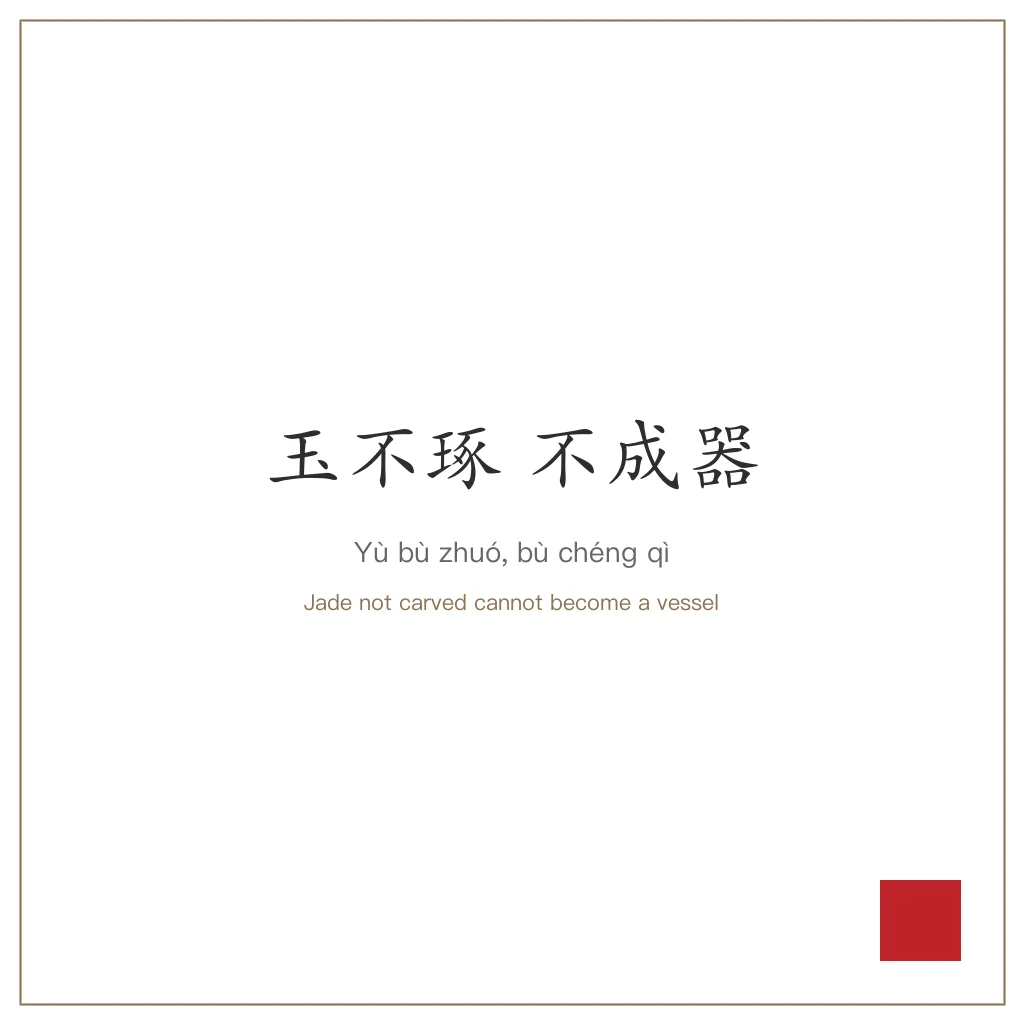
玉不琢不成器
Yù bù zhuó bù chéng qì
"Jade cannot become a vessel without being carved"
Quick Answer
玉不琢不成器 (Yù bù zhuó bù chéng qì) — "Jade cannot become a vessel without being carved." Literal translation: If jade is not cut and polished, it cannot become a useful or beautiful object. Talent without discipline and training is wasted. Hardship and effort are necessary to develop your potential into something valuable.
Character Analysis
If jade is not cut and polished, it cannot become a useful or beautiful object
Meaning & Significance
Talent without discipline and training is wasted. Hardship and effort are necessary to develop your potential into something valuable.
Raw jade looks like a rock. It’s dull, rough, and unremarkable. You’d walk past it on the ground without a second glance.
But inside that rock is something extraordinary. You just can’t see it yet.
玉不琢不成器. Jade cannot become a vessel without being carved.
The Characters
- 玉 (yù): Jade — the most prized gemstone in Chinese culture, symbolizing purity, virtue, and nobility
- 不 (bù): Not
- 琢 (zhuó): To carve, to polish, to cut and grind
- 不 (bù): Not
- 成 (chéng): To become, to accomplish
- 器 (qì): A vessel, a container, a useful implement — by extension, a person of talent or capability
Where It Comes From
This proverb comes from the Three Character Classic (《三字经》, San Zi Jing), one of the most influential educational texts in Chinese history, composed in the 13th century. For over seven hundred years, this was the first text every Chinese child memorized.
The full passage reads:
“Jade that is not polished is not a treasure. A person who does not learn will not know the Way.” (玉不琢,不成器。人不学,不知义。)
The Three Character Classic was designed to be memorized by children as young as three. Every line contained a lesson. This one taught something fundamental: nature gives you raw material, but you must do the work yourself.
The Philosophy
Potential vs. Achievement
This proverb draws a sharp distinction between potential and achievement. Jade is inherently valuable — but raw jade is nearly worthless compared to polished jade. The value isn’t in the material. It’s in what’s been done with it.
This is why the proverb resonates so strongly in education and self-improvement. A naturally intelligent person who never studies is like unpolished jade. The potential was always there. It just never became anything.
The Necessity of Hardship
The carving process is not gentle. It involves cutting, grinding, friction, and patience. The proverb isn’t saying “practice a little.” It’s saying you must go through difficulty to become something. The friction is not optional. It’s the mechanism of transformation.
This runs counter to a modern culture that avoids discomfort. The proverb says: the discomfort is the point. Without it, you stay a rock.
The Teacher’s Role
Implicit in the proverb is the presence of a craftsman — someone who sees the jade inside the rock and has the skill to bring it out. In the educational context, this is the teacher. In life, it’s a mentor, a coach, or anyone who pushes you beyond what you’d push yourself.
When Chinese Speakers Use It
Scenario 1: A parent encouraging a struggling student
“I hate piano practice. It’s too hard.”
“Yù bù zhuó bù chéng qì. The difficulty is what makes you good. If it were easy, everyone would do it.”
Scenario 2: A teacher motivating a talented but lazy student
“She’s the smartest in the class, but she never does homework.”
“Classic case of yù bù zhuó bù chéng qì. All that talent going to waste.”
Scenario 3: Self-reflection after a difficult experience
“That project was brutal. But I learned more in six months than in the previous three years.”
“That’s how it works. Yù bù zhuó bù chéng qì. The friction is what polishes you.”
In Western Culture
This proverb is widely quoted in English-language self-help, education, and martial arts circles. It’s often cited alongside the Japanese concept of kaizen (continuous improvement) as an Eastern philosophy of disciplined growth.
Tattoo Advice
Excellent choice.
The 6-character version 玉不琢不成器 works well as a two-line vertical tattoo. It’s a positive, aspirational message about the value of hard work and self-discipline.
The single character 琢 (zhuó — to carve, to polish) also works as a standalone tattoo. It captures the essence: the process of refinement.
This is one of the least controversial Chinese proverb tattoos you could choose. It’s universally positive and deeply meaningful.
Frequently Asked Questions
What does "玉不琢不成器" mean in English?
Jade cannot become a vessel without being carved
How do you pronounce "玉不琢不成器"?
The pinyin pronunciation is: Yù bù zhuó bù chéng qì
What is the deeper meaning of "玉不琢不成器"?
Talent without discipline and training is wasted. Hardship and effort are necessary to develop your potential into something valuable.
What is the literal translation of "玉不琢不成器"?
If jade is not cut and polished, it cannot become a useful or beautiful object
Related Proverbs
一夫当关,万夫莫开
Yī fū dāng guān, wàn fū mò kāi
"One man guards the pass, ten thousand cannot break through"
只要功夫深,铁杵磨成针
Zhǐyào gōngfu shēn, tiě chǔ mó chéng zhēn
"If your effort is deep enough, an iron pestle can be ground into a needle"
善人难做
shàn rén nán zuò
"It's hard to be a good person"
龙生龙,凤生凤,老鼠生儿会打洞
lóng shēng lóng, fèng shēng fèng, lǎo shǔ shēng ér huì dǎ dòng
"Dragons beget dragons, phoenixes beget phoenixes, and mice beget offspring that can dig holes"
物以类聚,人以群分
Wù yǐ lèi jù, rén yǐ qún fēn
"Things gather by kind; people divide by group"
猫哭老鼠假慈悲
Māo kū lǎo shǔ jiǎ cí bēi
"When the cat cries over the mouse, it is fake mercy"