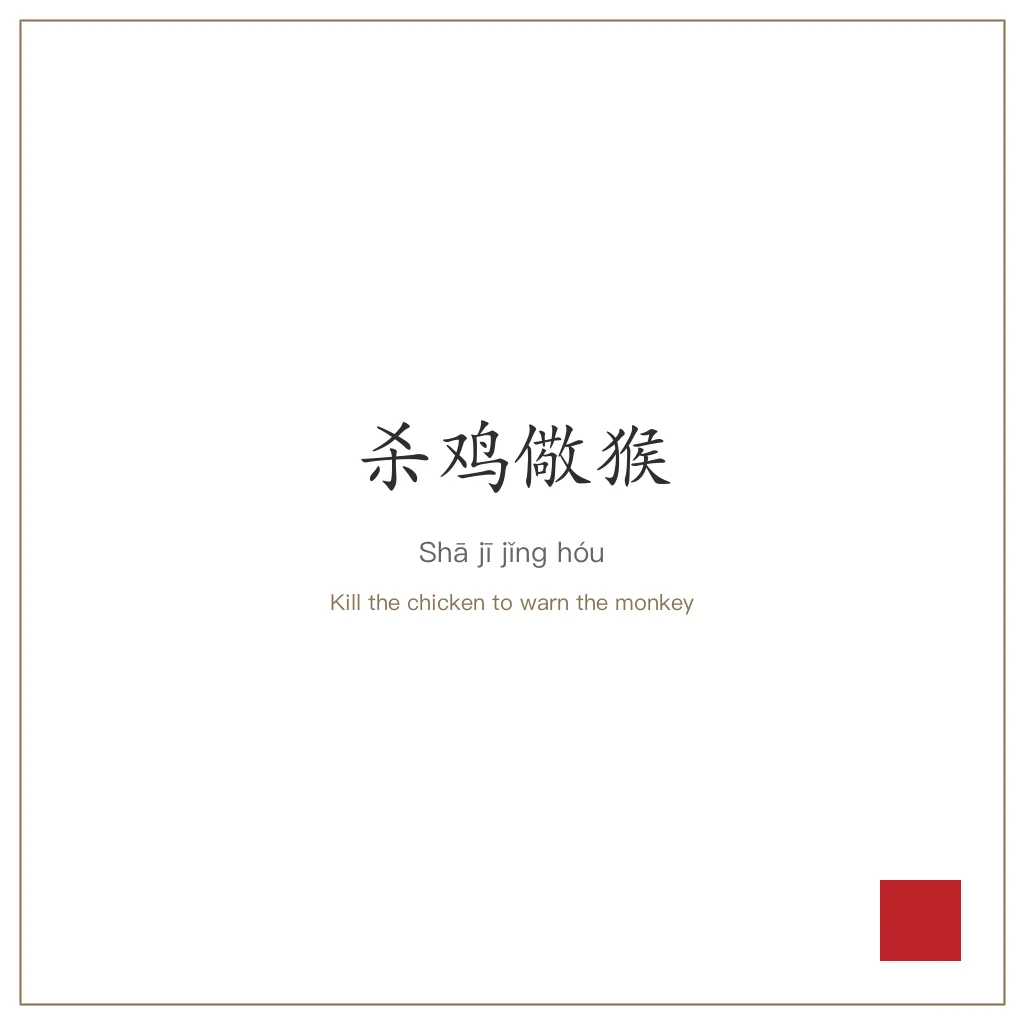
杀鸡儆猴
Shā jī jǐng hóu
"Kill the chicken to warn the monkey"
Quick Answer
杀鸡儆猴 (Shā jī jǐng hóu) — "Kill the chicken to warn the monkey." Literal translation: Slaughter a chicken in front of a monkey to make the monkey behave, since monkeys are smart enough to understand the threat. Punish one person as a warning to others. Make an example of someone to deter similar behavior from the rest.
Character Analysis
Slaughter a chicken in front of a monkey to make the monkey behave, since monkeys are smart enough to understand the threat
Meaning & Significance
Punish one person as a warning to others. Make an example of someone to deter similar behavior from the rest.
You can’t discipline everyone. But you don’t have to.
You just have to discipline one person publicly enough that everyone else gets the message.
杀鸡儆猴. Kill the chicken to frighten the monkey.
The Characters
- 杀 (shā): To kill, to slaughter
- 鸡 (jī): Chicken
- 儆 (jǐng): To warn, to deter, to make an example of
- 猴 (hóu): Monkey
This is a four-character chengyu (成语).
Where It Comes From
This proverb has roots in Chinese folk wisdom and appeared in written form during the Ming Dynasty in the vernacular novel Journey to the West (《西游记》). In the story, the Monkey King (Sun Wukong) encounters situations where the strategy of punishing one to control many is employed.
The metaphor draws on the observation that monkeys are highly intelligent and social animals. When a monkey sees a chicken being killed, it understands the implication: “That could be me.” The monkey doesn’t need to be threatened directly — observing the fate of another is sufficient to change its behavior.
The proverb was widely used in imperial China as a governance strategy. When a local official wanted to crack down on corruption or crime, they would publicly punish one offender — severely — to discourage everyone else.
The Philosophy
Efficient Deterrence
This proverb is fundamentally about efficiency. You have limited resources. You can’t punish every wrongdoer. But you need compliance. The solution: make one punishment so visible and memorable that it prevents a hundred future violations.
This is the same logic behind public executions in medieval Europe, mandatory minimum sentences in modern law, and firing a high-profile employee to signal a culture change.
The Ethics of Examples
The proverb doesn’t judge whether this strategy is moral — it simply describes it. And it’s used both approvingly and critically in Chinese discourse. A parent might use it approvingly (“I punished one child so the others would behave”). A citizen might use it critically (“They fired him as an example to the rest of us”).
The Chicken’s Perspective
There’s an implicit tragedy in the proverb. The chicken isn’t the worst offender. The chicken is simply the most convenient target. In real-world applications, the person punished as an “example” isn’t always the most guilty — they’re the most visible, the most vulnerable, or the least powerful.
When Chinese Speakers Use It
Scenario 1: A manager disciplining a team
“The boss fired Zhang publicly for being five minutes late. Now everyone arrives early.”
“Shā jī jǐng hóu. Zhang wasn’t the only one who was late. He was just the example.”
Scenario 2: Government or legal context
“They gave that celebrity a maximum sentence for a minor offense.”
“Classic shā jī jǐng hóu. They’re sending a message to the whole industry.”
Scenario 3: In parenting
“I scolded the older one in front of the younger ones. Now all of them do their homework.”
“Shā jī jǐng hóu. It works, but the older one resents it.”
In Western Culture
This proverb is well-known internationally and is frequently cited in Western discussions of Chinese politics, business management, and legal strategy. The English equivalent is “making an example of someone.” The proverb is often mentioned in Western media coverage of Chinese anti-corruption campaigns.
Tattoo Advice
Not recommended.
This proverb is about punishment and manipulation. Getting it as a tattoo suggests you think about power dynamics in a predatory way. It reads as threatening: “I’ll hurt someone to control you.”
The individual characters could work: 儆 (jǐng — to warn/deter) is a meaningful standalone character. But the full proverb carries too much aggressive subtext for a tattoo.
Frequently Asked Questions
What does "杀鸡儆猴" mean in English?
Kill the chicken to warn the monkey
How do you pronounce "杀鸡儆猴"?
The pinyin pronunciation is: Shā jī jǐng hóu
What is the deeper meaning of "杀鸡儆猴"?
Punish one person as a warning to others. Make an example of someone to deter similar behavior from the rest.
What is the literal translation of "杀鸡儆猴"?
Slaughter a chicken in front of a monkey to make the monkey behave, since monkeys are smart enough to understand the threat
Related Proverbs
兵者,诡道也
Bīng zhě, guǐ dào yě
"War is a path of deception"
树倒猢狲散
Shù dǎo hú sūn sàn
"When the tree falls, the monkeys scatter"
不战而屈人之兵,善之善者也
Bù zhàn ér qū rén zhī bīng, shàn zhī shàn zhě yě
"To subdue the enemy's troops without fighting is the highest of the high"
高筑墙,广积粮,缓称王
Gāo zhù qiáng, guǎng jī liáng, huǎn chēng wáng
"Build high walls, store abundant grain, delay claiming kingship"
知己知彼,百战不殆
Zhī jǐ zhī bǐ, bǎi zhàn bù dài
"Know yourself and know your enemy; in a hundred battles you will never be in danger"
鹬蚌相争,渔翁得利
Yù bàng xiāng zhēng, yú wēng dé lì
"The snipe and the clam grapple; the fisherman catches both"