树倒猢狲散
Shù dǎo hú sūn sàn
"When the tree falls, the monkeys scatter"
Quick Answer
树倒猢狲散 (Shù dǎo hú sūn sàn) — "When the tree falls, the monkeys scatter." Literal translation: When a tree falls down, the monkeys that were living in it scatter in all directions. When a powerful person loses their position or influence, their followers, allies, and hangers-on abandon them and go their separate ways.
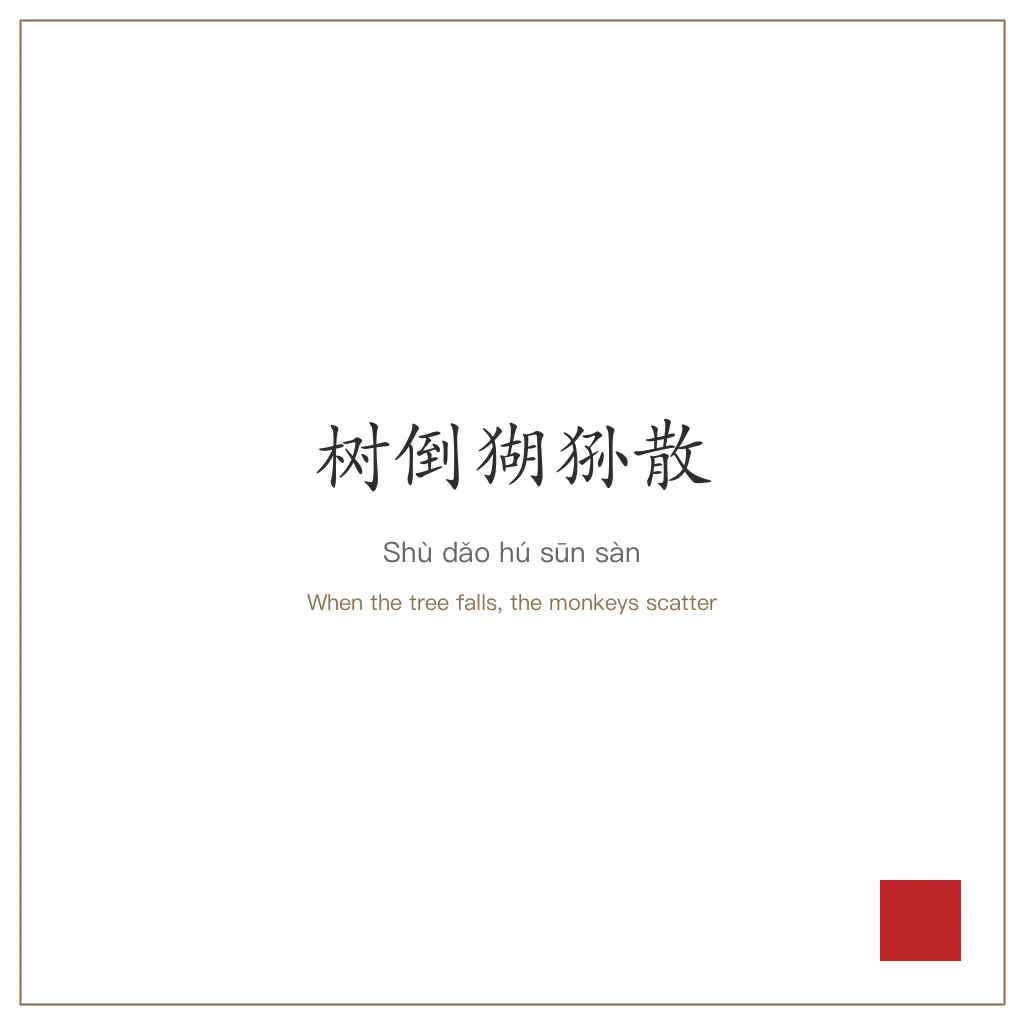
Character Analysis
When a tree falls down, the monkeys that were living in it scatter in all directions
Meaning & Significance
When a powerful person loses their position or influence, their followers, allies, and hangers-on abandon them and go their separate ways.
A CEO is fired. Within a week, half their team has found new jobs. A political leader loses an election. Allies who once crowded around them suddenly can’t return calls fast enough.
树倒猢狲散. The tree falls, and the monkeys scatter.
The Characters
- 树 (shù): Tree
- 倒 (dǎo): To fall, to collapse
- 猢狲 (hú sūn): Monkeys, macaques (literary/classical term)
- 散 (sàn): To scatter, to disperse
Where It Comes From
This proverb comes from the Song Dynasty (960–1279 CE). It’s attributed to Zen Master Ji Gong (济公), who used it to describe the behavior of the followers of the powerful minister Qin Hui (秦桧), the notorious chancellor who orchestrated the wrongful execution of the general Yue Fei.
When Qin Hui finally fell from power, all the sycophants, opportunists, and dependents who had benefited from his patronage vanished overnight. Ji Gong observed:
“When the tree falls, the monkeys scatter.”
The metaphor is brutal in its simplicity. The monkeys never cared about the tree. They cared about what the tree provided — shelter, food, height. When the tree is gone, there’s no reason to stay.
The Philosophy
Transactional Relationships
This proverb exposes the transactional nature of most power-based relationships. The monkeys didn’t betray the tree. They were never loyal to the tree in the first place. They were loyal to what the tree did for them.
This is uncomfortable because it applies to almost every institution. Employees follow a CEO for the salary and the prestige, not out of personal devotion. Political allies support a leader for access and influence, not love. When the source of benefits disappears, the loyalty disappears with it.
Not Always Cynical
The proverb isn’t always used as criticism. Sometimes it’s simply an observation of reality. When a company closes, of course people find new jobs. That’s not betrayal — that’s survival. The monkeys need a tree, not this particular tree.
The proverb becomes critical only when the monkeys pretended their loyalty was deeper than it was. The hypocrisy, not the departure, is what stings.
The Tree’s Delusion
There’s a secondary lesson for the tree: don’t mistake dependence for devotion. If everyone around you benefits from your position, test whether they’d still be there without it. The ones who stay are your real friends. The rest are monkeys.
When Chinese Speakers Use It
Scenario 1: After a boss is fired
“Did you see? Five people from the director’s team already updated their LinkedIn.”
“Shù dǎo hú sūn sàn. They were never loyal to him. They were loyal to his budget.”
Scenario 2: Discussing a political scandal
“The governor’s allies are already distancing themselves.”
“Classic shù dǎo hú sūn sàn. They’ll find another tree to climb.”
Scenario 3: Describing a social circle after someone loses status
“When he was rich, his phone never stopped ringing. Now? Nothing.”
“Shù dǎo hú sūn sàn. Fair-weather friends.”
In Western Culture
This proverb is well-known among English speakers who study Chinese culture and politics. It’s frequently used in Western media to describe the collapse of political patronage networks. The closest English equivalent is “rats abandoning a sinking ship,” though the Chinese version is more vivid and less judgmental.
Tattoo Advice
Proceed with caution.
This proverb has a cynical edge — it’s essentially about fake friends and opportunism. Getting this tattoo suggests you’ve been burned by people who abandoned you. That’s either deeply meaningful or deeply bitter, depending on how you frame it.
The abbreviated form 树倒猢狲 (4 characters) works well visually. But consider whether this is a message you want to carry permanently.
Frequently Asked Questions
What does "树倒猢狲散" mean in English?
When the tree falls, the monkeys scatter
How do you pronounce "树倒猢狲散"?
The pinyin pronunciation is: Shù dǎo hú sūn sàn
What is the deeper meaning of "树倒猢狲散"?
When a powerful person loses their position or influence, their followers, allies, and hangers-on abandon them and go their separate ways.
What is the literal translation of "树倒猢狲散"?
When a tree falls down, the monkeys that were living in it scatter in all directions
Related Proverbs
狐假虎威
Hú jiǎ hǔ wēi
"The fox exploits the tiger's ferocity"
杀鸡儆猴
Shā jī jǐng hóu
"Kill the chicken to warn the monkey"
水能载舟,亦能覆舟
Shuǐ néng zài zhōu, yì néng fù zhōu
"Water can carry a boat, but it can also overturn it"
高筑墙,广积粮,缓称王
Gāo zhù qiáng, guǎng jī liáng, huǎn chēng wáng
"Build high walls, store abundant grain, delay claiming kingship"