杯弓蛇影
Bēi gōng shé yǐng
"The reflection of a bow in the cup mistaken for a snake"
Quick Answer
杯弓蛇影 (Bēi gōng shé yǐng) — "The reflection of a bow in the cup mistaken for a snake." Literal translation: In a wine cup, the reflection of a hanging bow appears as a snake's shadow, causing the drinker to believe he has swallowed a serpent. This proverb describes groundless fears and suspicions — anxiety that exists only in the mind, fed by an imagination that turns innocent shadows into monsters. Used when Commonly used to describe someone being paranoid without cause — a hypochondriac, a jealous lover seeing rivals where none exist, or anyone who has talked themselves into fearing an illusion.
Character Analysis
In a wine cup, the reflection of a hanging bow appears as a snake's shadow, causing the drinker to believe he has swallowed a serpent
Meaning & Significance
This proverb describes groundless fears and suspicions — anxiety that exists only in the mind, fed by an imagination that turns innocent shadows into monsters.
Historical Origin
Modern Usage
Commonly used to describe someone being paranoid without cause — a hypochondriac, a jealous lover seeing rivals where none exist, or anyone who has talked themselves into fearing an illusion.
You see something. Your heart races. You’re certain it’s there.
Then someone turns on the light. And you realize: it was just a shadow.
That’s the snake in the cup.
The Characters
- 杯 (bēi): Cup, glass — the vessel
- 弓 (gōng): Bow — the weapon hanging on the wall
- 蛇 (shé): Snake — the imagined threat
- 影 (yǐng): Shadow, reflection — the illusion itself
The Story
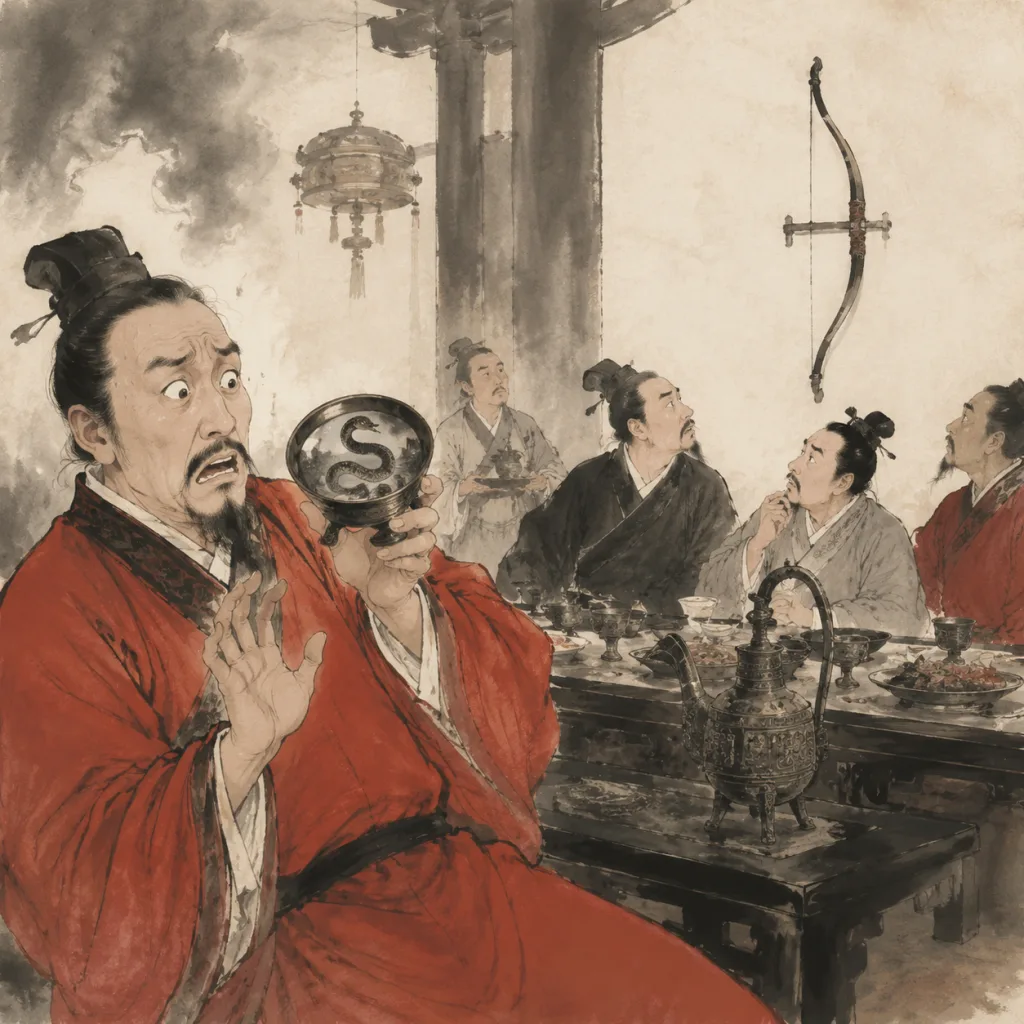
Yue Guang, a Jin Dynasty official, invited a friend to his home for wine. The friend noticed what he thought was a small snake swimming in his cup. Too polite to refuse, he drank anyway.
Immediately afterward, he fell seriously ill — convinced the snake was living inside him.
Weeks passed. Yue Guang visited his ailing friend and learned the cause. Puzzled, he returned home and examined the room. On the wall hung a decorative bow. When he poured wine and set it in the same spot, he saw it: the bow’s reflection in the cup looked exactly like a snake.
He called his friend back, showed him the bow, and demonstrated the illusion. The friend’s illness vanished — instantly cured the moment he understood there had never been a snake at all.
When People Use This
Someone is convinced their coworker is plotting against them — but every “sign” is a misinterpretation of innocent behavior. Someone fears a disease despite every test coming back negative. Someone sees infidelity in a partner’s polite smile at a stranger.
These are all snakes in the cup.
The mind is the most powerful poison. And the most powerful medicine. What you believe, you make real — at least inside your own body.
Why It Matters
The story comes from a medical context, not a philosophical one: the friend literally became physically ill from a psychological cause. The cure was not medicine but understanding.
The proverb warns us that our senses lie, our fears magnify, and our certainties are often illusions. Before you suffer over something, ask yourself: is there a snake in the cup, or just a bow on the wall?
See Also
- The Frog in the Well — also about the limits of perception
- Avoiding Suspicion — on the delicacy of suspicion between people, and its proper limits
Frequently Asked Questions
What does "杯弓蛇影" mean in English?
The reflection of a bow in the cup mistaken for a snake
How do you pronounce "杯弓蛇影"?
The pinyin pronunciation is: Bēi gōng shé yǐng
What is the deeper meaning of "杯弓蛇影"?
This proverb describes groundless fears and suspicions — anxiety that exists only in the mind, fed by an imagination that turns innocent shadows into monsters.
What is the literal translation of "杯弓蛇影"?
In a wine cup, the reflection of a hanging bow appears as a snake's shadow, causing the drinker to believe he has swallowed a serpent
Where does "杯弓蛇影" come from?
This proverb originates from 晋书 · 乐广传 (Book of Jin, Biography of Yue Guang) (Jin Dynasty (~3rd century AD)), attributed to Yue Guang (乐广) story, recorded in the Book of Jin.
Related Proverbs
厚德载物
Hòu dé zài wù
"Great virtue sustains and bears all things"
羊毛出在羊身上
Yáng máo chū zài yáng shēn shàng
"The wool comes from the sheep's own body"
刻舟求剑
Kè zhōu qiú jiàn
"Carve a mark on the boat to seek the sword"
捡了芝麻,丢了西瓜
Jiǎn le zhī ma, diū le xī guā
"Picked up sesame seeds, lost the watermelon"
宽以待人,严以律己
Kuān yǐ dài rén, yán yǐ lǜ jǐ
"Be generous toward others, but hold yourself to a higher standard"
敏而好学,不耻下问
Mǐn ér hào xué, bù chǐ xià wèn
"Quick-minded and loving to learn, not ashamed to ask those below"