守株待兔
Shǒu zhū dài tù
"Stand by a tree stump waiting for hares"
Quick Answer
守株待兔 (Shǒu zhū dài tù) — "Stand by a tree stump waiting for hares." Literal translation: Guard (守) the stump (株) and wait for (待) a hare (兔) — a farmer saw a hare crash into a stump and die, then abandoned his plow to wait at the stump for more hares to do the same. Relying on a one-time stroke of luck instead of doing actual work. Trying to replicate a fluke success by waiting for it to happen again rather than putting in consistent effort. The proverb mocks misplaced faith in coincidence. Used when Used to mock someone who relies on past luck, expects a fluke to repeat itself, or refuses to do real work in hopes of an easy windfall. Often aimed at lazy entrepreneurs, gamblers, or people who wait for opportunities instead of creating them.
Character Analysis
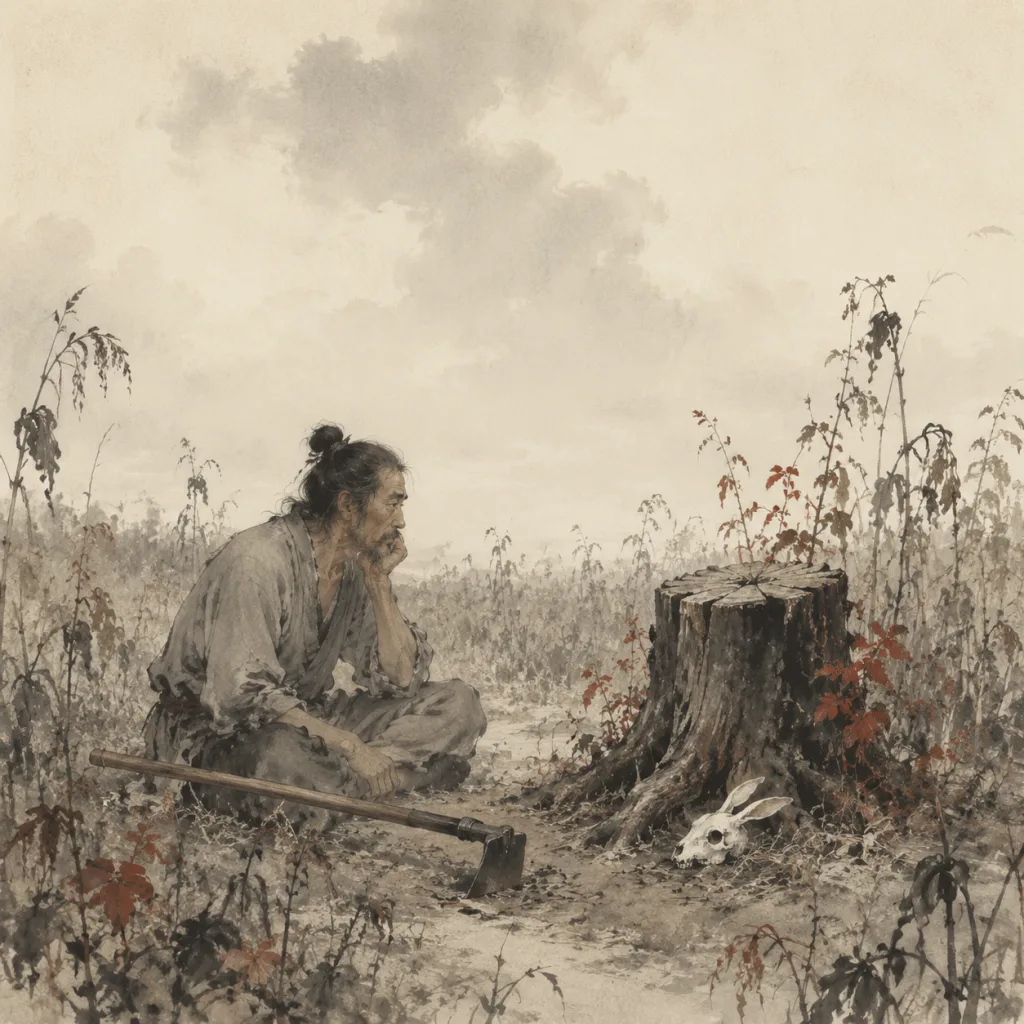
Guard (守) the stump (株) and wait for (待) a hare (兔) — a farmer saw a hare crash into a stump and die, then abandoned his plow to wait at the stump for more hares to do the same.
Meaning & Significance
Relying on a one-time stroke of luck instead of doing actual work. Trying to replicate a fluke success by waiting for it to happen again rather than putting in consistent effort. The proverb mocks misplaced faith in coincidence.
Historical Origin
Modern Usage
Used to mock someone who relies on past luck, expects a fluke to repeat itself, or refuses to do real work in hopes of an easy windfall. Often aimed at lazy entrepreneurs, gamblers, or people who wait for opportunities instead of creating them.
The startup raised one round of funding from a cold pitch and decided cold pitching was their entire strategy. They never built outbound. They never improved the product. Two years later, they were still cold pitching — and the rabbits had stopped coming.
守株待兔. Waiting by the stump for a hare.
守株待兔 Meaning: A Quick Definition
- Literal meaning: A farmer, having once seen a hare crash headfirst into a tree stump and break its neck, abandoned his plow and waited by the stump for more hares to do the same.
- Figurative meaning: Relying on a single lucky break to repeat itself rather than putting in real work. Expecting effortless success based on one past fluke.
- Story origin: Han Feizi (《韩非子》), chapter “Wudu” (五蠹, “The Five Vermin”), written by the Legalist philosopher Han Fei around 280–233 BC.
- Moral: Don’t confuse coincidence with strategy. Don’t pattern-match on a sample size of one.
- Modern examples: The lottery player who bases their system on one early win; the trader who waits for the same setup that worked once; the suitor who expects to bump into their future spouse the same way they met their ex.
In one line: 守株待兔 describes anyone who stops working because they’re too busy waiting for lightning to strike the same spot twice.
The Characters
- 守 (shǒu): To guard, keep watch, hold onto
- 株 (zhū): Tree stump (the part left in the ground after felling)
- 待 (dài): To wait for, await
- 兔 (tù): Hare, rabbit
This is a four-character chengyu (成语).
Where It Comes From
The story appears in Han Feizi, one of the foundational texts of Chinese Legalism. Han Fei used it as a critique of conservative scholars who wanted to govern their own age by copying policies from a legendary ancient king:
“In the state of Song, there was a man plowing his field. A hare came running by, struck a tree stump, broke its neck, and died. The man put down his plow and waited by the stump, hoping to catch more hares the same way. He became the laughingstock of the state.”
Han Fei’s point was political: don’t govern the present by waiting for the conditions of the past to return. The fable has since been generalized to anyone who relies on past luck instead of present effort.
The story also has a sad postscript in the original: after waiting by the stump, the farmer’s fields grew over with weeds and his own state was conquered — a reminder that betting on coincidence has compounding costs.
The Philosophy
The Trap of Single-Event Learning
The farmer made an elementary statistical error: he treated a one-off event as a pattern. One hare hit a stump once, so he reorganized his entire livelihood around the assumption that hares hitting stumps was a recurring phenomenon.
This is closer to a common cognitive bias than we’d like to admit. Modern psychology calls it availability bias — we over-weight recent, vivid events when predicting the future. The hare hitting the stump was vivid and unforgettable, so the farmer built a worldview on it.
The Difference Between Luck and Strategy
A real strategy survives the loss of any single lucky break. A lucky streak dressed up as a strategy collapses the moment the luck runs out. The farmer’s misfortune is that he could not tell which one he had.
The Chinese tradition has a parallel saying that captures the contrast: 不劳而获 (bù láo ér huò) — “to gain without working.” 守株待兔 is its comic face: the fantasy of gaining without working, acted out.
Han Fei’s Political Target
In context, Han Fei wasn’t really mocking farmers. He was mocking Confucian scholars who argued that the ruler should imitate the sage-kings of antiquity. His argument: those kings succeeded because their policies fit their time. Copying their policies in a different era is as foolish as waiting by a stump for the next hare. The right answer is to design policies that fit the present reality.
This makes 守株待兔 one of the earliest Chinese arguments for evidence-based policy over historical precedent.
When Chinese Speakers Use It
Scenario 1: Mocking a lazy business strategy
“He made one viral video in 2021 and he’s been making the exact same video for three years waiting for it to go viral again.”
“Shǒu zhū dài tù. He needs a new playbook.”
Scenario 2: Calling out gambling mentality
“She won big on her first trip to Macau. Now she flies back every month.”
“Classic shǒu zhū dài tù. The house always wins eventually.”
Scenario 3: Warning against nostalgia
“Some people want to bring back the entire 1990s policy playbook because the economy was good then.”
“That’s shǒu zhū dài tù thinking. The stump is still there, but the hares have moved on.”
In Western Culture
The closest Western parallels:
- “Waiting for Godot” — captures the waiting-without-delivery aspect, but Beckett’s play is existential rather than comic.
- “The goose that laid the golden eggs” — captures the one lucky animal theme, but the moral is about greed, not laziness.
- “Lightning never strikes the same place twice” — captures the statistical reality that the farmer ignores, but is more of a folk belief than a story.
The Chinese proverb is more specific and more actionable than any of these. It names a behavior (waiting by the stump) and lets the listener draw the conclusion.
Tattoo Advice
Not recommended as a tattoo.
This proverb is, at its core, a joke at someone’s expense. Getting 守株待兔 inked on your body would read to a Chinese speaker like getting “SUCKER” tattooed on your forehead — a permanent announcement of gullibility.
If you love the story and want it on your skin anyway, the better move is imagery: a hare mid-collision with a tree stump, or a farmer sitting patiently beside a stump in a field of weeds. The visual carries the fable without the self-deprecation of the words.
See Also
Frequently Asked Questions
What does "守株待兔" mean in English?
Stand by a tree stump waiting for hares
How do you pronounce "守株待兔"?
The pinyin pronunciation is: Shǒu zhū dài tù
What is the deeper meaning of "守株待兔"?
Relying on a one-time stroke of luck instead of doing actual work. Trying to replicate a fluke success by waiting for it to happen again rather than putting in consistent effort. The proverb mocks misplaced faith in coincidence.
What is the literal translation of "守株待兔"?
Guard (守) the stump (株) and wait for (待) a hare (兔) — a farmer saw a hare crash into a stump and die, then abandoned his plow to wait at the stump for more hares to do the same.
Where does "守株待兔" come from?
This proverb originates from 《韩非子》 (Han Feizi) (Warring States period (战国), c. 280–233 BC), attributed to 韩非 (Han Fei).
Related Proverbs
履霜,坚冰至
Lǚ shuāng, jiān bīng zhì
"Treading on frost — solid ice is arriving"
一阴一阳之谓道
Yī yīn yī yáng zhī wèi dào
"One yin and one yang, this is called the Dao"
酒逢知己千杯少,话不投机半句多
Jiǔ féng zhījǐ qiān bēi shǎo, huà bù tóujī bàn jù duō
"With a kindred spirit, a thousand cups of wine are too few; when conversation doesn't click, half a sentence is too much"
白驹过隙
Bái jū guò xì
"A white colt passes a crevice"
一年之计在于春,一日之计在于晨
Yī nián zhī jì zài yú chūn, yī rì zhī jì zài yú chén
"The plan for a year lies in spring; the plan for a day lies in the morning"
没有规矩,不成方圆
Méiyǒu guīju, bù chéng fāngyuán
"Without compass and square, you cannot make squares and circles"