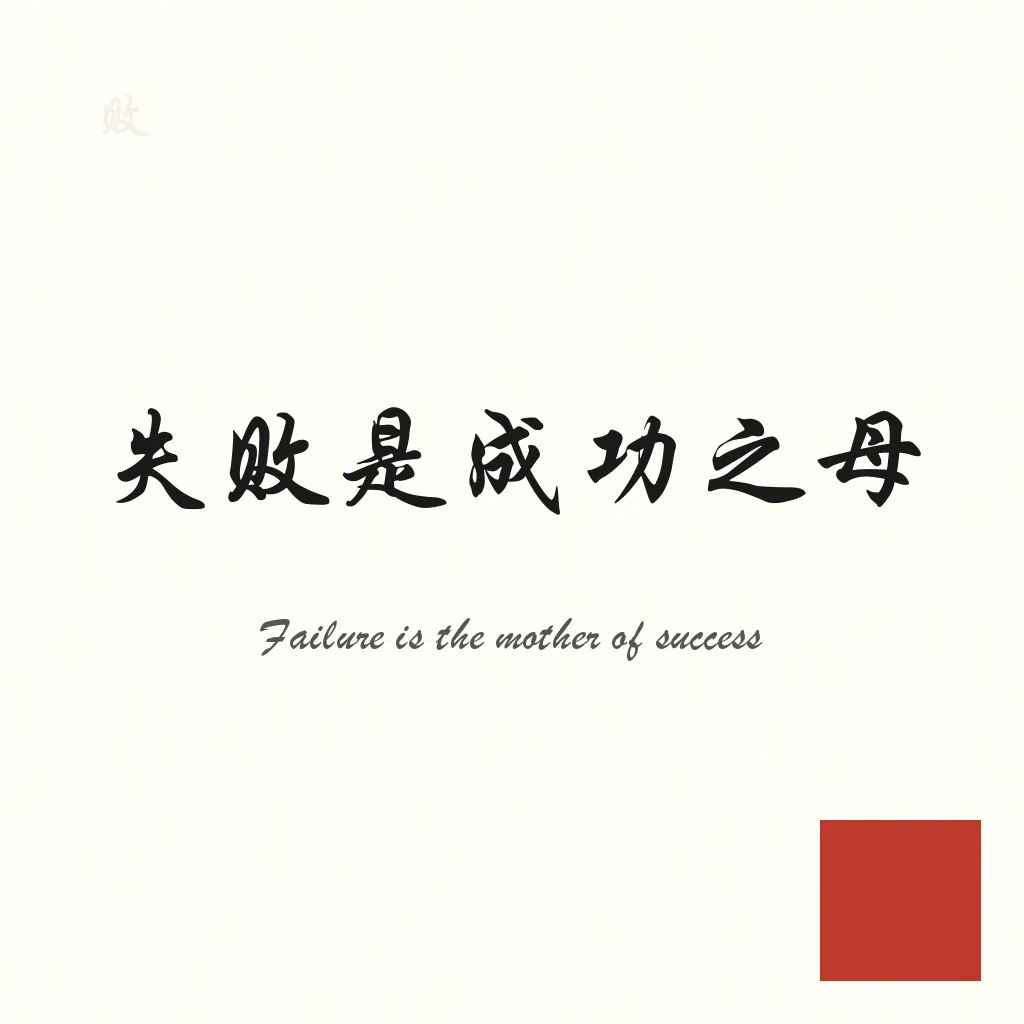
失败是成功之母
Shībài shì chénggōng zhī mǔ
"Failure is success's mother"
Quick Answer
失败是成功之母 (Shībài shì chénggōng zhī mǔ) — "Failure is success's mother." Literal translation: Failure is the mother of success. This proverb reframes failure as a necessary precursor to success—each failure contains lessons that enable future achievement, making setbacks not endpoints but essential steps on the path to success.
Character Analysis
Failure is the mother of success
Meaning & Significance
This proverb reframes failure as a necessary precursor to success—each failure contains lessons that enable future achievement, making setbacks not endpoints but essential steps on the path to success.
About This Entry
You failed. It hurts. You want to give up.
This proverb says: don’t. This failure might be exactly what you needed.
The Characters
- 失败 (shībài): Failure, to fail
- 是 (shì): Is
- 成功 (chénggōng): Success, to succeed
- 之 (zhī): Possessive particle (of)
- 母 (mǔ): Mother
The metaphor is family relationship: failure is the mother, success is the child. This means:
- Success is born from failure
- Failure precedes success
- Failure produces success
- Without failure, success cannot exist
The image is tender. A mother gives birth to her child. Failure gives birth to success. The relationship isn’t accidental — it’s essential.
Where It Comes From
This proverb has become so common that its origins are unclear. It appears in various forms in Chinese literature and has been popularized in modern times through education and media.
A similar concept appears in the Han Feizi (韩非子) from the 3rd century BCE: “Failure is the root of success” (败者成功之本).
The proverb gained particular prominence in the 20th century, used to encourage resilience in the face of setbacks. It’s now one of the most commonly quoted proverbs about failure and perseverance.
The Philosophy
The Productivity of Failure
Failure isn’t just disappointment. It’s information. Each failure teaches something — what doesn’t work, what to avoid, where the limits are. This information is necessary for eventual success.
The Sequential Relationship
You don’t succeed despite failure; you succeed because of it. The failures came first, taught their lessons, and made success possible. Success without failure is rare; success after failure is normal.
Reframing Setbacks
The proverb changes how we experience failure. Instead of “I failed, therefore I’m a failure,” it suggests “I failed, therefore I’m one step closer to success.” The same event, different framing.
The Necessity of Persistence
If failure is the mother of success, then stopping after failure means abandoning the child before it’s born. You must continue through the failure to reach the success it was producing.
When Chinese Speakers Use It
Scenario 1: Consoling after a failure
“I didn’t get the job. I feel terrible.”
“失败是成功之母. You learned something from this. The next interview will be better.”
Scenario 2: Explaining past success
“How did you build such a successful company?”
“Three failed companies first. 失败是成功之母. Each failure taught me something I used later.”
Scenario 3: Encouraging risk-taking
“What if I fail?”
“Then you’ll have learned. 失败是成功之母. The only real failure is not trying.”
Scenario 4: Children’s encouragement
A parent to a child who fell while learning to ride a bike: “失败是成功之母. Get up. Try again. Each fall teaches you.”
Tattoo Advice
Good choice — encouraging, resilient, universally relevant.
This proverb has several strengths:
- Encouraging: Reframes failure positively.
- Universal: Everyone fails; everyone needs this message.
- Simple: Easy to understand.
- Well-known: Widely recognized.
Length considerations:
7 characters. Short. Fits almost anywhere.
No need to shorten: Already concise.
Design considerations:
The mother/child imagery could be incorporated, or abstract imagery of transformation and growth.
Tone:
This is an encouraging, resilient proverb. It’s about perseverance through difficulty. The energy is hopeful and forward-looking.
Alternatives:
- 吃一堑,长一智 — “Stumble once, grow one wisdom” (6 characters, similar theme)
- 失败乃成功之母 — Same proverb with 乃 instead of 是 (7 characters, slightly more formal)
Frequently Asked Questions
What does "失败是成功之母" mean in English?
Failure is success's mother
How do you pronounce "失败是成功之母"?
The pinyin pronunciation is: Shībài shì chénggōng zhī mǔ
What is the deeper meaning of "失败是成功之母"?
This proverb reframes failure as a necessary precursor to success—each failure contains lessons that enable future achievement, making setbacks not endpoints but essential steps on the path to success.
What is the literal translation of "失败是成功之母"?
Failure is the mother of success
Related Proverbs
天将降大任于是人也
Tiān jiāng jiàng dà rèn yú shì rén yě
"When heaven is about to confer a great responsibility on a person"
受人滴水之恩,当以涌泉相报
Shòu rén dī shuǐ zhī ēn, dāng yǐ yǒng quán xiāng bào
"When receiving the grace of a drop of water, repay it with a surging spring"
车到山前必有路
Chē dào shān qián bì yǒu lù
"When the cart reaches the mountain, there will surely be a road"
不是冤家不聚头
Bù shì yuān jiā bù jù tóu
"Only true adversaries are fated to encounter each other"
入国问禁,入乡问俗
Rù guó wèn jìn, rù xiāng wèn sú
"When entering a country, ask about its prohibitions; when entering a village, ask about its customs"
画虎画皮难画骨,知人知面不知心
Huà hǔ huà pí nán huà gǔ, zhī rén zhī miàn bù zhī xīn
"Painting a tiger, you can paint its skin but not its bones; knowing a person, you know their face but not their heart"