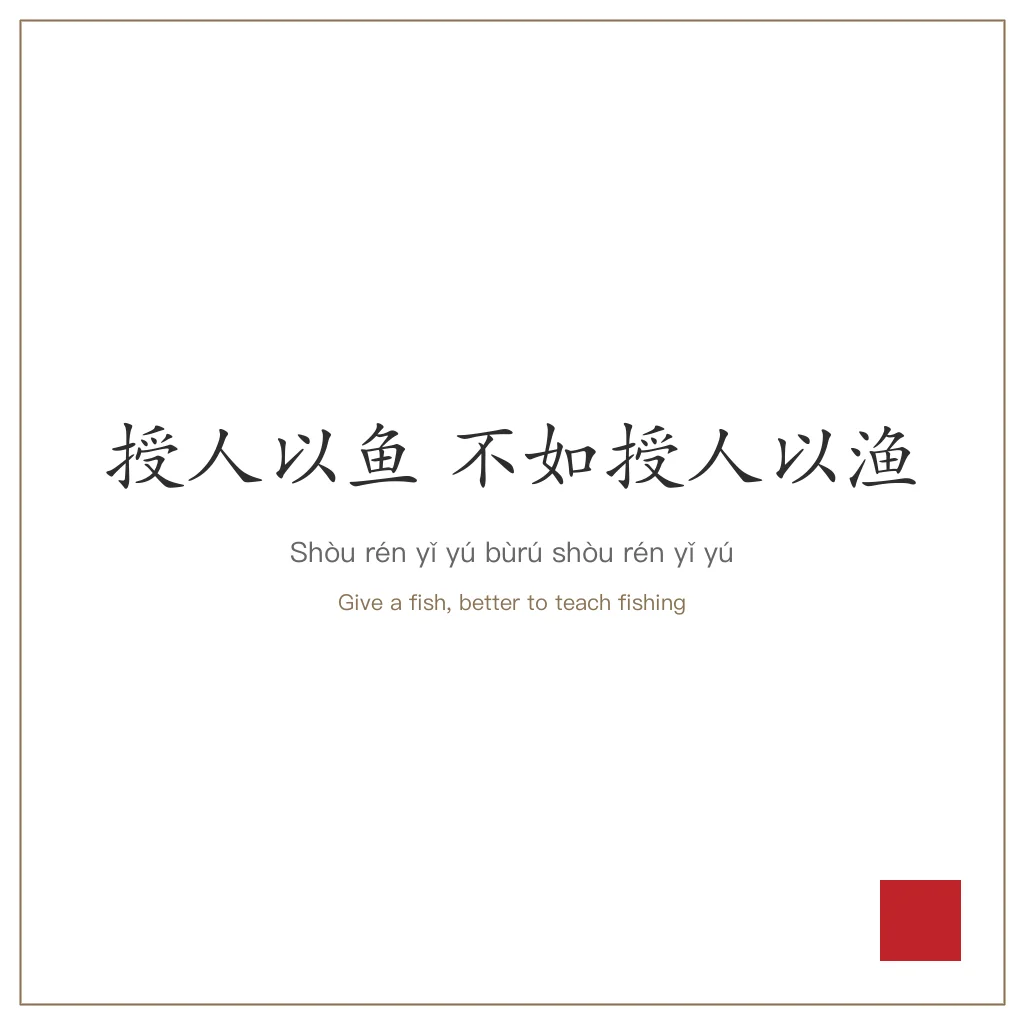
授人以鱼不如授人以渔
Shòu rén yǐ yú bùrú shòu rén yǐ yú
"Giving someone a fish is not as good as teaching them to fish"
Quick Answer
授人以鱼不如授人以渔 (Shòu rén yǐ yú bùrú shòu rén yǐ yú) — "Giving someone a fish is not as good as teaching them to fish." Literal translation: The characters literally break down as 'give person fish not as good as give person fishing'—a direct comparison between providing immediate sustenance versus传授 the skill to obtain it independently. This proverb encapsulates a fundamental tension in how we help others: the choice between solving someone's immediate problem versus equipping them to solve it themselves. It suggests that true assistance addresses not just present need but future capability. The philosophy extends beyond charity into education, parenting, management, and international development.
Character Analysis
The characters literally break down as 'give person fish not as good as give person fishing'—a direct comparison between providing immediate sustenance versus传授 the skill to obtain it independently.
Meaning & Significance
This proverb encapsulates a fundamental tension in how we help others: the choice between solving someone's immediate problem versus equipping them to solve it themselves. It suggests that true assistance addresses not just present need but future capability. The philosophy extends beyond charity into education, parenting, management, and international development.
Historical Origin
About This Entry
Your friend calls at midnight. Again. Car trouble. Needs a ride. You’ve picked him up three times this month. Each time, you tell yourself you’re being a good friend. But something gnaws at you—maybe the problem isn’t the car.
This proverb is about that gnawing feeling.
The Characters
- 授 (shòu): To give, bestow, or confer—specifically something passed from a superior or teacher to a recipient
- 人 (rén): Person, people
- 以 (yǐ): With, by means of—marks the instrument or method
- 鱼 (yú): Fish
- 不 (bù): Not
- 如 (rú): As, like; in this context, “not as good as”
- 渔 (yú): Fishing—the method, technique, or skill of catching fish
Notice the last two characters. Both are pronounced yú, but the first is the creature, the second is the craft. That’s the entire point compressed into a homophone.
Where It Comes From
The proverb appears in the Huainanzi (淮南子), a philosophical compendium compiled around 139 BCE under the patronage of Liu An, the King of Huainan. This wasn’t a casual collection—it was a grand synthesis of Daoist, Confucian, and Legalist thought, written by a team of scholars at Liu An’s court.
The full passage reads: “故授人以鱼,不如授人以渔;授人以粟,不如授人以稼。” (Therefore, giving someone fish is not as good as teaching them to fish; giving someone grain is not as good as teaching them to farm.)
Liu An himself was a fascinating figure—the grandson of Liu Bang, the founder of the Han Dynasty. He was a scholar, an alchemist (legend says he discovered tofu while searching for the elixir of immortality), and ultimately a tragic figure who committed suicide after being accused of treason. His kingdom of Huainan was a center of intellectual ferment, where scholars debated how to govern, how to live, and how to help others effectively.
The Huainanzi wasn’t offering folk wisdom. It was making a political argument about how the state should treat its people. Relief in times of famine was necessary, yes—but the real work of governance was creating the conditions for self-sufficiency.
The Philosophy
Here’s where it gets interesting. The ancient Chinese weren’t the only ones to figure this out.
The Greek philosopher Mencius—who, coincidentally, was writing around the same time as the early Daoist texts—made a similar point: “If you give a man a fish, he eats for a day. If you teach him to fish, he eats for a lifetime.” Wait, no. That’s not Mencius at all. That’s the Western misattribution that’s become so common it shows up on motivational posters in corporate break rooms.
The actual Western parallel comes closer to the Stoics, particularly Seneca’s letters. In Epistulae Morales 95, Seneca argues that philosophy isn’t about giving people answers—it’s about teaching them how to think. “We give them precepts,” he writes, “not remedies.”
Same impulse. Different metaphor.
The core insight is about dependency versus autonomy. When you solve someone’s problem for them, you create a relationship: helper and helped. It feels good to be the helper. But if you keep solving their problems, something calcifies. The helped person starts to see themselves as someone who needs help. The helper starts to see themselves as indispensable.
This is why the proverb uses “not as good as” rather than “don’t do it.” Giving fish isn’t wrong. Sometimes people are starving. They need to eat today. The fishing lesson can wait until they have the strength to hold the rod.
The question is: what are you building toward?
When Chinese Speakers Use It
The proverb shows up in three main contexts:
Education and Parenting
“Just help him with his math homework,” her sister said. “It’ll take five minutes.”
“授人以鱼,不如授人以渔,” Lin replied. “He needs to learn the method, not just copy my answers. Otherwise he’ll be stuck again tomorrow.”
Management and Training
The new hire keeps asking the same questions about the database. At first, Chen answered each one patiently. After the fifth email about the same query, she walked over to his desk.
“Let me show you something,” she said, pulling up a chair. “授人以鱼不如授人以渔—I’m not going to answer these anymore. I’m going to teach you how to find the answers yourself.”
International Development
This is where the proverb gets quoted in policy discussions. Foreign aid, development loans, humanitarian assistance—critics invoke this proverb to argue that handouts create dependency. Whether that’s fair or oversimplified depends on the specific case, but the Huainanzi would recognize the debate.
Tattoo Advice
This is a solid choice for a tattoo, with some caveats.
The proverb is eight characters. In vertical script, that’s manageable—roughly the length of a forearm. In horizontal, it’s a lot of text. Think about where you’re putting it.
Stylistically, the characters are well-balanced. 授 and 渔 are the most complex, each with 11 strokes. The others are simpler, creating visual rhythm.
Culturally, this is about as safe as it gets. It’s not a curse, not a pun, not something that will embarrass you in a Beijing boardroom. It expresses a universally admired value: self-reliance through education.
The main risk is that it’s very famous. Native speakers will recognize it instantly. That’s not bad—you’re not hiding anything—but it’s like getting “Carpe Diem” in Latin. People will have opinions.
If you want something less common but philosophically adjacent, consider:
- 自强不息 (zì qiáng bù xī) — “Self-strengthening without ceasing” — from the I Ching. More abstract, equally noble.
- 学以致用 (xué yǐ zhì yòng) — “Learn in order to apply” — emphasizes the practical purpose of education.
- 独立自主 (dú lì zì zhǔ) — “Independent and autonomous” — simpler, more modern, less poetic.
But if you want the fishing proverb, go for it. Just make sure your tattoo artist gets the character 渔 (fishing) right, not 鱼 (fish). Otherwise you’ll be walking around saying “teaching a man to fish is worse than giving him a fish,” and that’s the opposite of the point.
Frequently Asked Questions
What does "授人以鱼不如授人以渔" mean in English?
Giving someone a fish is not as good as teaching them to fish
How do you pronounce "授人以鱼不如授人以渔"?
The pinyin pronunciation is: Shòu rén yǐ yú bùrú shòu rén yǐ yú
What is the deeper meaning of "授人以鱼不如授人以渔"?
This proverb encapsulates a fundamental tension in how we help others: the choice between solving someone's immediate problem versus equipping them to solve it themselves. It suggests that true assistance addresses not just present need but future capability. The philosophy extends beyond charity into education, parenting, management, and international development.
What is the literal translation of "授人以鱼不如授人以渔"?
The characters literally break down as 'give person fish not as good as give person fishing'—a direct comparison between providing immediate sustenance versus传授 the skill to obtain it independently.
Where does "授人以鱼不如授人以渔" come from?
This proverb originates from 淮南子 (Huainanzi) (Western Han dynasty (~139 BCE)), attributed to Liu An (刘安) and scholars.
Related Proverbs
拔苗助长
Bá miáo zhù zhǎng
"Pulling up shoots to help them grow"
出其不意,攻其不备
Chū qí bù yì, gōng qí bù bèi
"Appear where the enemy does not expect; attack where they are unprepared"
狗改不了吃屎
Gǒu gǎi bù liǎo chī shǐ
"A dog can't stop eating excrement"
行百里者半九十
Xíng bǎi lǐ zhě bàn jiǔ shí
"For those traveling a hundred miles, ninety is only half"
少说为妙
Shǎo shuō wéi miào
"Less said, better — silence is often the wisest choice"
过了这个村,没了这个店
Guò le zhè ge cūn, méi le zhè ge diàn
"Opportunities are fleeting; seize them when they appear"